

Hammer
Rob Earl provides an overview of the technique for throwing the hammer.
The event occurs in a cage with moveable doors to accommodate left and right-handed throwers for safety purposes. The throwing circle measures 2.135m in diameter and is either single-use or concentric within a discus circle. The hammer is a steel ball attached to the wire via a spindle inserted into the ball, and the wire is attached to a steel handle. The athlete holds the hammer handle, and specialist shoes assist in reducing friction and gaining maximum speed while turning with the hammer. A specialist fingerless leather glove is used to give protection.
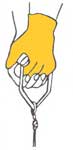 The components of the throw
The following explanations are for a right-handed thrower.
The grip
The athlete's left hand, wearing the glove, grips the handle between the 2nd and 3rd joints of the fingers and the right hand is then placed inside the handle on top of the left hand.
The swings
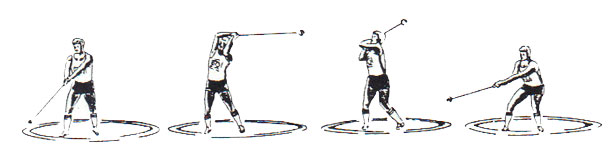
The athlete stands at the rear of the circle, feet parallel, with their back towards the throwing sector. The preliminary swings are used to commence the momentum of the throw.
The athlete generally uses two swings but more or less can be used. The swing starts from behind the right side of the body, taking the hammer forward away from the body and over the head. This will achieve a low point of the hammer ball in front of the body and a high point behind.
The entry
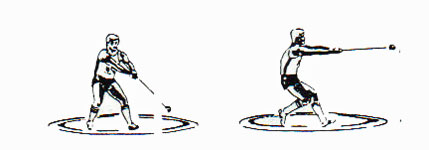
At the end of the swings, the athlete is about to enter the turning phase. With the hammer directly in front of the thrower, the low point, the turns commence. The hammer is pushed to the left, and the turns are started. The shoulders are relaxed, the head passive, the trunk engaged, knees and hips flexed, and feet remain in contact with the circle.
The turns
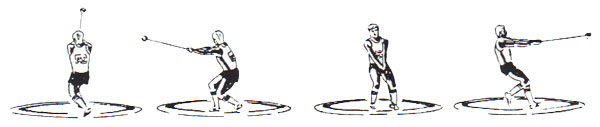
These are a series of movements performed to increase the speed of the hammer using balance through the feet and power from the legs and hips. The feet are working together throughout the throw. The number of turns performed is a personal choice, but 3 or 4 are generally used.
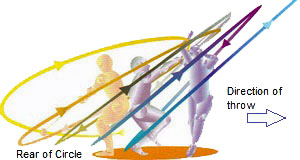
The right foot is turned through the toes and the left through the heel. At 6 o'clock, once the right foot has completed its movement, it is lifted off the circle with a driving action from the right knee. The right hip rotates back and around, with the right foot touching down onto the circle at approximately 3 o'clock. The hammer is then accelerated by force transferred from the continually rotating right foot through the knees and hips to the downward path of the hammer back to the low point [12 o'clock]. Please note that a force can only be applied to the hammer ball when both feet are in contact with the circle and the hammer ball on its downward path. The left foot continues to turn throughout and maintains contact with the circle. The upper body remains passive, shoulders relaxed with straight arms. The next turn starts at the low point [12 o'clock].
The following diagram provides a side-on view of the path of the hammer ball and its movement across the circle through each turn to release.
The delivery
After the turns performed by the thrower have accelerated the hammer head to its maximal velocity, the thrower now stays with both feet in contact with the circle but still rotating and, at the same time, extending through ankles, knees and hips to drive the hammer upward and out to a position opposite the low point, known as the high point. In the drive upward, the feet point at "9 o'clock", and the left side of the body is blocked. At this point, the hammer is released.
Heel-Toe Turn Footwork
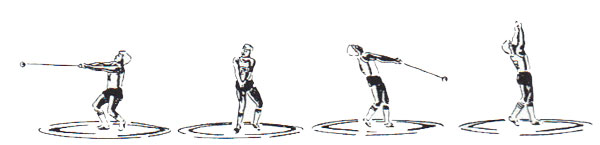
After the preliminary swings start the turn on the heel of the left foot and the ball of the right foot. As the hammer ball passes "9 o'clock" lift the right foot off the ground and rotate on the outside of the left foot. As the hammer ball approaches "6 o'clock" shift the left foot onto the ball of the foot. The right foot is put down on the ground as the hammer ball reaches "3 o'clock". For the remaining part of the turn, from "3 o'clock" to "12 o'clock", be on the balls of both feet. When the hammer ball reaches "12 o'clock" the left foot shifts onto the heel, and the next turn commences.
Optimum Distance
The distance achieved in the hammer is dependent on three parameters:
- The height of release of the hammer.
- The angle of release of the hammer.
- The speed of release of the hammer.
The parameter that has the most significant effect on the potential distance is the speed of release of the hammer.
Optimum Release Angle
Each athlete has a unique release velocity and release angle combination that depends on their size, strength, and throwing technique. Each athlete has their own specific optimum release angle. Bartonietz (2000)[2] identifies that the optimum release angle for a world-class hammer thrower may be 40.5°± 3.5°.
Release velocity and angle
Isele et al. (2012)[1] produced a report that provides an in-depth biomechanical analysis of the final of the men's and women's hammer competition at the 2011 IAAF Athletics World Championships held in Daegu. Mathematically the key factors that influence the distance achieved are the release velocity, angle of release and height of release. The range and average values for release velocity and release angle for the finalists were:
| Release velocity | Release angle | |||
| Range | Average | Range | Average | |
| Male | 27.4 - 28.3m/sec | 27.9m/sec | 38.9°-44.1° | 41.5° |
| Female | 26.4 - 27.8m/sec | 27.2m/sec | 36.6°-43.1° | 41.1° |
The information may suggest that an ideal angle of release is in the range of 41° to 42° for both men and women, which perhaps supports Bartonietz (2000)[2] findings of 40.5°± 3.5°.
Conclusion
Although the description of the throw components is separately headed, it is essential to remember that the throw should be viewed as a series of continual movement processes to create maximal velocity and distance.
Specifications
The weight specification for the hammer depends on gender and age.
| Gender\Age | 11-12 | 13-14 | 15-16 | 17-19 | 20-34 |
| Male | 3 kg | 4 kg | 5 kg | 6 kg | 7.26 kg |
| Female | 3 kg | 3 kg | 3 kg* | 4 kg | 4 kg |
* British Athletics changes of implements for 2014
| Gender\Age | 35-49 | 50-59 | 60-69 | 70-79 | 80+ |
| Male | 7.26 kg | 6 kg | 5kg | 4kg | 3kg |
| Gender\Age | 35-49 | 50-59 | 60-69 | 70-74 | 75+ |
| Female | 4 kg | 3kg | 3kg | 3kg | 2kg |
Training Programs
A training program has to be developed to meet the athlete's individual needs and consider many factors: gender, age, strengths, weaknesses, objectives, training facilities etc. As all athletes have different needs, a single program suitable for all athletes is not possible.
Typical week's winter training for 68-metre senior hammer thrower
- Monday - Weight training. Squats 5 x 5 @ 140k, Clean 2 x 5 @ 95k. 3x3 @ 110k, Snatch 5x5@ 70k, Jerk 5 x 8 @ 40k, Core training.
- Tuesday - Throws. 10 x 6k, 10 x 7.72k, 6 x short 9k, 5 x 40m sprints, 10 x 5 low hurdle bounds.
- Wednesday - Weight training. Jump squats 5x5 @ 40k, Clean 5x5@ 90-95k, Snatch 2x5@ 70k, 3x3@ 80k, Bench press 5x5 @ 60k, Core training .
- Thursday -Throws. 10 x 6k, 12 x 7.26k, 6 x 8k, 30 x putt throw for core strength .
- Friday - Rest day.
- Saturday - Throws. 10 x 6k, 12 x 7.26k, 6 x short 8k, 5 x 30m sprints, 5 x standing long jump, 5 x overhead shot throws.
- Sunday - Active recovery rest day.
Training Pathway
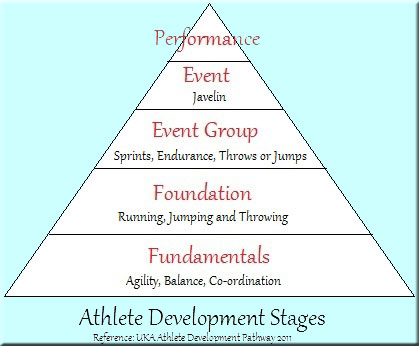
Athletes in the Event Group stage
The following is an annual training program suitable for athletes in the Event Group Development stage:
Athletes in the Event stage
The following is an example of a specific annual training program suitable for athletes in the Event development stage:
Evaluation Tests
The following evaluation tests can be used to monitor the athlete's development:
- 60-metres speed test.
- Quadrathlon.
- Strength test - upper body (Bench Press).
- Strength test - lower body (Leg Press).
- Sit-Ups test - abdominal strength.
- Sit and Reach test - lower back and hamstring test.
- Vertical Jump test.
Rules of Competition
The competition rules for this event are available from:
References
- ISELE, R. et al. (2012) Biomechanical Analysis of the Hammer Throw at the 13th IAAF World Championships in Athletics in Daegu [WWW] Available from: https://www.osp-hessen.de [Accessed September 2012]
- BARTONIETZ, K. (2000) Hammer throwing problems and prospects. In: ZATSIORSKY, V. (2000) Biomechanics in sport, Blackwell Science, Oxford, pp. 458-486
Page Reference
If you quote information from this page in your work, then the reference for this page is:
- EARL, R. (2011) Hammer [WWW] Available from: https://www.brianmac.co.uk/hammer/index.htm [Accessed
About the Author
Rob Earle has been involved as a thrower for 30+ years. He was an under-20 international hammer thrower and competed for the AAA on two occasions. Rob is a British Athletics Hammer National Coach Development Program member and delivers mentoring training through the Local Coach Development Program workshops in the East of England. He is a British Athletics coach and coach education tutor, a Sports therapist and a tutor on sports massage courses.