

Performance Profiling
If a 1500-metre runner appeared to lack speed towards the end of a race, an effective coach would observe this and design a training program to address this situation. However, psychological factors are often hidden, whereas speed, or lack of it, can be directly observed. The intervention must be tailored to meet specific needs if psychological factors require attention.
A direct question does not always provide the full facts since athletes can be reluctant, at least initially, to discuss such things. A critical problem for coaches seeking to address such issues is how to work out the problem when they cannot observe what is going on in their athlete's minds. An approach that is becoming popular in sports is Performance Profiling.
Objectives
Over the past few years, Performance Profiling has become a new tool in the athlete & coach's armoury. Performance Profiling has three major purposes:
- To aid in identifying an appropriate intervention
- To maximise the athlete's motivation and adherence to the program
- To monitor any changes over time
Factors that influence Performance
The factors that can influence performance are:
- Lifestyle and support
- Movement Skills
- Physical Preparation
- Psychological Behaviour
- Technical & Tactical skills
Process
Performance Profiling comprises four steps:
- Step 1 - The Coach outlines the Performance Profiling process
- Step 2 - The athlete identifies the characteristics of an elite athlete in their sport/event
- Step 3 - The athlete rates each in terms of a level of importance and self-assessment
- Step 4 - Athlete and Coach analyse the results and agree on a way forward
Step 1
The first step is for the coach to introduce the idea of Performance Profiling to the athlete and how it can help direct training in areas of specific need. The coach must explain that the process will focus on the athlete's current feelings regarding their competition preparation.
A sense of mutual trust can aid this process, and it should be made clear that any information gained about the athlete will remain strictly confidential. Coaches should stress that no right or wrong answers are involved in the process, but an honest appraisal will facilitate a more productive outcome.
Step 2
The athlete becomes actively involved in this step of the process, and the following question should be directed to the athlete:
What, in your opinion, are the fundamental qualities or characteristics of an elite athlete in your sport/event?
Spend five to ten minutes listing the qualities or characteristics the athlete feels are essential. In this step, the athlete should identify 15 to 20 features. If an athlete finds this problematic, the coach can use prompts, but it is for the athlete to decide what parts are chosen. The coach should get the athlete to list the vital psychological factors. This same process can be applied to technical skills or physical attributes, such as strength, speed, agility, balance etc.
Step 3
The next step is for the athlete to rate each identified characteristic.
- On a scale of zero (not at all important) to 10 (vital), the athlete rates the perceived importance of each characteristic for an elite performer in their particular sport/event.
- The athlete uses the same zero to 10 scale to rate their current perception of themselves to an ideal state of 10.
- A calculation is then carried out to determine the 'Discrepancy' value. The higher discrepancies indicate areas that may need to be addressed through training or other interventions.
Step 4
The table below provides an example of these calculations for part of an athlete's performance profile.
| Characteristics identified by the athlete | Athlete's
perceived level of importance (API) |
Athlete's self-assessment (ASA) |
Discrepancy (10-ASA) × API |
| Confidence | 10 | 8 | 20 |
| Concentration | 9 | 6 | 36 |
| Control | 10 | 7 | 30 |
| Commitment | 9 | 8 | 18 |
| Refocusing after errors | 9 | 5 | 45 |
| Enjoyment | 8 | 8 | 16 |
For this particular athlete refocusing after errors and concentration are vital concerns that could be addressed. It can be via intervention strategies such as self-talk or a quick set routine, depending on the athlete's exact circumstances and preferences.
Reassessment should always relate to the characteristics identified in the initial profiling process and be conducted every four to eight weeks.
Alternative approach
- Coach outlines the Performance Profiling process.
- The athlete identifies a set of characteristics.
- The athlete assesses their performance against each characteristic (self-assessment).
- The coach assesses and rates the athlete against each characteristic.
- The athlete and coach analyse the results and agree on a way forward.
The coach-athlete relationship is much stronger when goals and targets are shared and agreed.
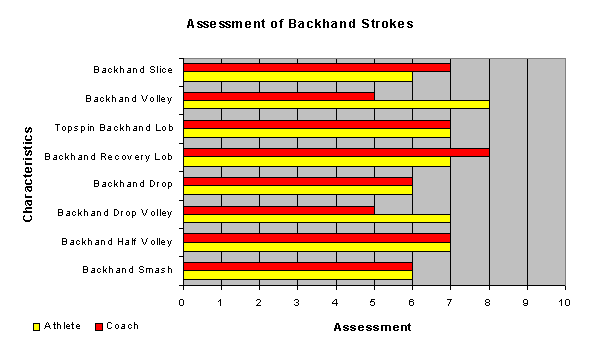
The figure below illustrates a tennis player's self-assessment (yellow) and the coach's assessment (red) of the athlete's backhand strokes on a scale of 0 (very poor) to 10 (excellent). It shows that the coach and athlete agree over most relevant characteristics but disagree over the backhand volley. In such circumstances, video analysis of the player's performance might be an excellent way to resolve such differences and produce agreement on how to proceed.
Benefits
Performance Profiling can help coaches develop a better understanding of their athletes by:
- Highlighting perceived strengths and weaknesses.
- Clarifying the athlete's and coach's vision of the critical characteristics of elite performance and highlighting any differences.
- Highlighting discrepancies between the athlete's and coach's assessment of performance.
- Providing a means of monitoring progress.
Genetic ‘Profiling‘ for Athletics and Sports Performance
Our genes control our biological systems, such as muscle, cartilage and bone formation, muscle energy production, lactic acid removal, and blood and tissue oxygenation. Research by Kambouris (2011)[2] identified that variations in the DNA sequence of these genes have an impact on an individual's components of fitness (endurance, speed, strength etc.), vulnerability to sports injury and nutritional requirements.
Knowing the appropriate gene DNA structure suitable for an athletic event or sport and the athlete's gene DNA may allow an athlete to select the most appropriate sport and plan their training and nutritional programmes to optimise health and performance.
Mauffulli & Merzesh (2007)[3] found that mutations in collagen called COL5A1 led to the structure supporting the tendon being more loosely connected, making the tendon less stable and perhaps more susceptible to injury.
Modern gym management software will help you keep all the athlete profiles organised.
Article Reference
Some of the information on this page is adapted from Crust (2002)[1] with Electric Word plc's kind permission.
References
- CRUST, L. (2002) Performance profiling: a coaching tool for pinpointing strengths and weaknesses, designing training strategies and building better communication with athletes. Peak Performance, 183, p. 7-9
- KAMBOURIS, M. (2011) Predictive genomics profiling in athletics and sports performance. Br J Sports Med, 45 (2), lecture 27
- MAUFFULLI, N & MERZESH, M. (2007) Genetic aspects of tendinopathy. Journal of Science and Medicine in Sport, 11 (3), p. 243-247
Page Reference
If you quote information from this page in your work, then the reference for this page is:
- MACKENZIE, B. (2003) Performance Profiling [WWW] Available from: https://www.brianmac.co.uk/perprofile.htm [Accessed