

Triple Jump
The triple jump comprises 4 phases: the approach phase, hop phase, step phase and the jump phase.
New Athletes
Start with the basic movements by having your athletes Hop, step, and jump from a standing start. The take-off foot should be the athlete's most muscular leg, as it is used in the Hop and the Jump phases.
Teach the hop phase by having the athlete do:
- a walking single-leg hop
- incorporate the circling action of the hopping leg
- multiple single leg hops with a circling leg, flat landing, and upright posture
Consecutive bounds duplicate the step and jump actions, and the athlete should do these with a double-arm effort and land full footed.
Combine the three phases of the jump by starting with Hop and Step combinations on the grass and then add the Jump phase. Emphasize carrying the momentum from one stage to the next with an even rhythm for each phase. Once the jump phases have been put together, slowly add steps to the run-up following the athlete's ability to control speed.
As in the long jump, the athlete's eyes should be focused beyond the pit for the entire jump.
Approach Phase
The approach run for the Triple Jump is similar to that of the Long Jump and the objective is to create the highest amount of speed that can be controlled throughout the triple jump hop, step and jump phases. The athlete's strength and technique determine the optimal run-up distance and speed.
The Hop Phase
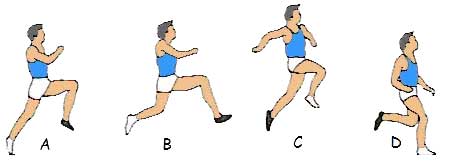
Coaching Points
- The take-off leg is fully extended (Fig A)
- Drive leg thigh should be nearly parallel to the ground at take-off and the foot relaxed (Fig A)
- The foot of the take-off leg is then pulled to the buttocks (Fig B)
- The drive leg rotates from in front of the body to behind it (Fig B-C)
- The take-off leg begins to pull forward (Fig C)
- As the thigh of the take-off leg reaches parallel, the lower portion of the leg extends past the knee, with the foot dorsiflexed (Fig C)
- Once the leg is extended, the athlete then forcefully drives the leg downwards, setting the athlete up for an active landing (Fig D)
The Step Phase
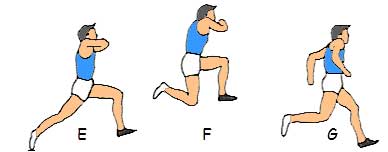
Coaching Points
- The take-off leg is fully extended with the drive leg thigh just below parallel to the ground (Fig E)
- The take-off leg stays extended behind the body with the heel held high (Fig F)
- The drive leg thigh is held parallel with the ground, the lower leg vertical, and the toe dorsiflexed (Fig F)
- The drive leg extends with a flexed ankle (creating a long lever) and snaps downward for a quick transition into the jump phase (Fig G)
The Jump Phase
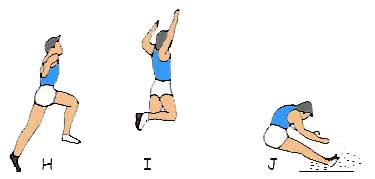
Coaching Points
- The take-off leg (the drive leg in the previous phases) is extended forcefully upon contact with the ground (Fig H)
- The free-leg thigh driving to waist level (Fig H)
- The arms drive forward and up - the torso should be held erect with the chin up and eyes looking beyond the pit - the legs move into a hang position with both thighs directly below the body, legs bent at the knees - the arms are extended overhead to slow rotation with the hands reaching for the sky (Fig I)
- The arms then drive forward - the legs swing forward - the position held until the heels hit the sand when the knees collapse, the hips rise, and the athlete slides through the sand (Fig J)
Arm Action
Using a single or a double arm action at take-off depends on the athlete's preference - the dual arm action provides more power.
Single-arm action
- The arm opposite the free leg drives forward and up to shoulder level.
- The angle at the elbow should be between 80 and 110 degrees.
Double arm action
- The lead arm crosses slightly in front of the body on the penultimate step of the approach phase.
- As the take-off step is initiated, the arm pauses next to the body rather than swinging behind as with a normal stride.
- As the take-off foot contacts the ground, both arms drive forward and up to shoulder height.
- The angle of the arms at the elbows will be higher than 90 degrees to create a more powerful impulse forward.
Foot Strike
Coaching Points
- In an active landing, the athlete's leg is extended, the ankle flexed, and the leg pulled down forcefully, striking the ground mid-foot.
- Upon contact, the body rolls forward over the foot onto the toes while pushing off the ground.
Jump Distribution
Aston Moore (BAF Junior event Coach, Triple Jump 1992) considers the appropriate distribution of the triple jump distance as follows - Hop 35%, Step 30% and Jump 35%.
Jonathan Edward's World Record
Watch Jonathan Edwards 1995 set a new world record of 18.16 metres for the triple jump and then, in the next jump, set a new world record, which still stands today, of 18.29 metres (Commentary in German). Jonathan has triple jumped 18.43 metres but is not in the record book because of a strong tailwind.
Ukraine's Inessa Kravets is the current women's world record holder, with a jump of 15.50 metres in 1995.
IAAF Men's Triple Jump World Record Progression (2007)
| Distance | Who | When | Where |
| 18.29 metres | Jonathan Edwards (GBR) | 07 Aug 1995 | Gothenburg |
| 18.16 metres | Jonathan Edwards (GBR) | 07 Aug 1995 | Gothenburg |
| 17.98 metres | Jonathan Edwards (GBR) | 18 Jul 1995 | Salamanca |
| 17.97 metres | Willie Banks (USA) | 16 Jun 1985 | Indianapolis |
| 17.89 metres | Joao Carlos de Oliveira (BRA) | 15 Oct 1980 | Mexico City |
| 17.44 metres | Viktor Sanyeyev (URS) | 17 Oct 1972 | Suchumi |
| 17.40 metres | Pedro Perez Duenas (CUB) | 05 Aug 1971 | Cali |
| 17.39 metres | Viktor Sanyeyev (URS) | 17 Oct 1968 | Mexico City |
| 17.27 metres | Nelson Prudencio (BRA) | 17 Oct 1968 | Mexico City |
| 17.23 metres | Viktor Sanyeyev (URS) | 17 Oct 1968 | Mexico City |
| 17.22 metres | Giuseppe Gentile (ITA) | 17 Oct 1968 | Mexico City |
| 17.10 metres | Giuseppe Gentile (ITA) | 16 Oct 1968 | Mexico City |
| 17.03 metres | Jozef Szmidt (POL) | 05 Aug 1960 | Olsztyn |
| 16.70 metres | Oleg Fedoseyev (URS) | 03 May 1959 | Nalchik |
| 16.59 metres | Oleg Rjahovsky (URS) | 19 Jul 1958 | Moscow |
| 16.56 metres | Adhemar Ferreira da Silva (BRA) | 16 Mar 1955 | Mexico City |
| 16.23 metres | Leonid Serbakov (URS) | 19 Jul 1953 | Moscow |
| 16.22 metres | Adhemar Ferreira da Silva (BRA) | 23 Jul 1952 | Helsinki |
| 16.12 metres | Adhemar Ferreira da Silva (BRA) | 23 Jul 1952 | Helsinki |
| 16.01 metres | Adhemar Ferreira da Silva (BRA) | 30 Sep 1951 | Rio de Janeiro |
| 16.00 metres | Adhemar Ferreira da Silva (BRA) | 03 Dec 1950 | Sao Paulo |
| 16.00 metres | Naoto Tajima (JPN) | 06 Aug 1936 | Berlin |
| 15.78 metres | John Metcalfe (AUS) | 14 Dec 1935 | Sydney |
| 15.72 metres | Chuhei Nambu (JPN) | 04 Aug 1932 | Los Angeles |
| 15.58 metres | Mikio Oda (JPN) | 27 Oct 1931 | Tokyo |
| 15.52 metres | Nick Winter (AUS) | 12 Jul 1924 | Paris |
| 15.52 metres | Dan Ahearn (USA) | 30 May 1911 | New York |
Training Programs
A training program has to be developed to meet the athlete's individual needs and consider many factors: gender, age, strengths, weaknesses, objectives, training facilities etc. As all athletes have different needs, a single program suitable for all athletes is not possible.
Training Pathway
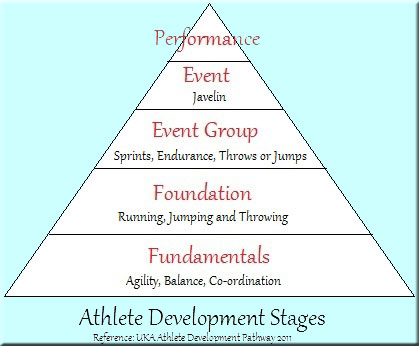
Athletes in the Event Group stage
The following is a basic annual training program suitable for athletes in the Event Group Development stage:
Athletes in the Event stage
The following is an example of a specific annual training program suitable for athletes in the Event Development stage:
Evaluation Tests
The following evaluation tests can be used to monitor the triple jump athlete's development:
- 10 stride test
- 60-metre speed test
- Flying 30 metres speed test
- Jumps Decathlon
- Leg Elastic Strength test
- Standing Long Jump test
- Strength test - upper body (Bench Press)
- Strength test - lower body (Leg Press)
- Sit-Ups test - abdominal strength
- Sit and Reach test - lower back and hamstring test
- Vertical Jump test
Rules of Competition
The competition rules for this event are available from:
Page Reference
If you quote information from this page in your work, then the reference for this page is:
- MACKENZIE, B. (2007) Triple Jump [WWW] Available from: https://www.brianmac.co.uk/triplejump/index.htm [Accessed